Cymru Marketing Journal - (CMJUK) - Online Business Journal & Digital Marketing Agency. Business News, Directory, SEO, Social Media Management, Advertising, Reviews, Forum, Market Research, Content Writing & Website Design. Thinking Local, Acting Global.

Category: CYBER CRIMINALS

Beware of Scammers On The Internet

Cyber Security Image

Beware Of Scammers On The Internet

IONOS - Official Partner

Cyber Crime

The internet has revolutionized the way we communicate, work, and do business. With the proliferation of social media and e-commerce, it has become easier than ever to connect with people and purchase goods and services. However, this convenience has also opened up opportunities for scammers and fraudsters to take advantage of unsuspecting individuals. In this article, we will discuss how to beware of scammers on the internet and social media.

  1. Be wary of unsolicited emails and messages

One of the most common ways scammers try to lure people into their schemes is through unsolicited emails and messages. These messages can be phishing scams, where the scammer poses as a trustworthy entity such as a bank or a social media platform, and asks for personal information or login details. They may also ask for payment upfront for a product or service that they never deliver.

To avoid falling for these scams, never give out your personal information or login details to anyone who asks for it through an unsolicited email or message. Be suspicious of emails or messages that ask you to click on a link or download an attachment.

  1. Do your research

Before making any purchase online or engaging in any business transaction, it’s important to do your research. Look up the company or individual you’re dealing with, and read reviews and feedback from other customers. Check the company’s website and social media pages to make sure they are legitimate and have a good reputation.

  1. Use secure payment methods

When making a payment online, use secure payment methods such as PayPal or credit cards. These payment methods offer protection in case the seller fails to deliver the product or service you paid for. Never wire money or use payment methods that offer no protection.

  1. Be cautious of too-good-to-be-true offers

Scammers often make offers that seem too good to be true, such as a job offer that requires no experience and promises a high salary, or a product that is priced significantly lower than its market value. Be cautious of these offers and do your research before accepting them. Remember, if something seems too good to be true, it probably is.

  1. Protect your personal information

Be careful about sharing your personal information online. Scammers can use your personal information such as your name, address, and phone number to steal your identity or to scam you. Use strong passwords, and avoid using the same password for multiple accounts.

  1. Report suspicious activity

If you come across any suspicious activity or suspect that you have been scammed, report it to the relevant authorities. This can include reporting the scammer to the website or social media platform where you encountered them or reporting the fraud to the police.

The Internet and social media can be great tools for communication, commerce, and entertainment. However, it’s important to be aware of the risks and to take steps to protect yourself from scammers and fraudsters. By following the tips outlined in this article, you can reduce your risk of falling victim to scams and enjoy the benefits of the online world safely.

My Personal Story.

I will first tell you how this article came about. I was contacted by someone on Facebook Messenger today in relation to content writing work and was told to contact someone else on Telegram who knows the first entity, but for all, I know they may have been one and the same person.

The person on Telegram said that I would be working with a legitimate company and was given the website address. Everything seemed fine and I was told to submit a 2500-word article and they would pay $5000. After checking out the company on Crunchbase I thought maybe that is the standard price they pay and was not going to question it even though I thought it was rather high. It is not as if I could phone anyone today seeing it is Easter Sunday.

Needless to say, similar pricing has also been advertised on places like Freelancer, Upwork, and People Per Hour. I have now washed my hands of these marketplaces.

Unfortunately I had to give them my bank details to get paid and fortunately for me, there is only about £10 in this particular account ( I was fortunate enough not to give my business account details or my default personal account). I am sure Sanatander will notify me if there is any suspicious activity.

I completed the assignment which I have now told them not to use as it is copyrighted by me and will be plagiarised as I publish it here.

It is not the first time people have tried to scam me and all I will say is a disability charity (yes you heard that right and the person I interacted with was the owner) in the USA on another site agreed on paying me $100 for an article however failed to pay after I submitted my work and I did not see one iota.

From now on I am taking a deposit and all payments will have to go through Stripe to protect my bank details. Thank God I used my brain and did not give them my business bank account.

I have now decided to disassociate myself from all content writing groups, pages, and marketplaces which are riddled with scammers.

Even companies like Freelancer, People Per Hour, and Upwork have an influx of scammers and have disclaimers warning people to be vigilant.

Yes, I am disappointed that I did not get paid because the entity claimed I need to pay the IRS $500, which rang alarm bells as they never gave me an invoice, therefore this was a scam.

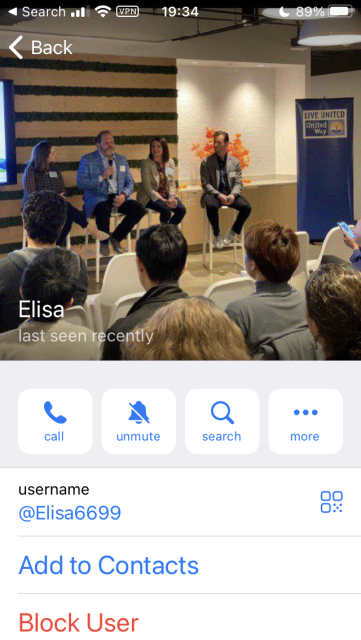
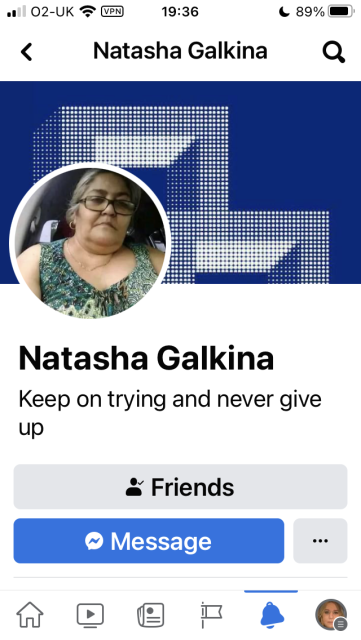
Here are the people I dealt with today and I have now turned off my notifications on Telegram and Facebook Messenger.
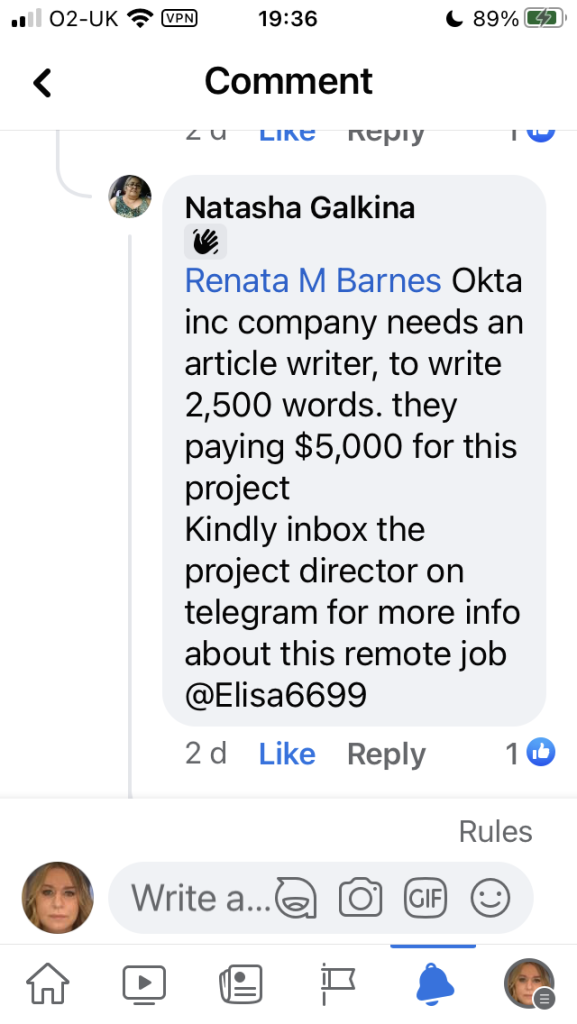
I will now contact Okta.com on Tuesday as they have UK Support and ask to speak to someone about this.

How many other people have these people that I dealt with today scammed?

I am livid but at the same time I have learned a valuable lesson and that is, if businesses do not want to work on your terms then there is something wrong, especially if they do not send company receipts and pretend to show receipts from Banks that can easily be made up in photoshop as I suspect the receipt that I received was done.

I am tired of all the scam callers whereby I have been forced to silence my phone and stop them calling me, usually trying to sell trading bitcoin and when you say you’re not interested they go to say “Why are you not interested” or get aggressive. One person threatened to come and pay me a visit. I am tired of all these entities trying to steal from you.

If you get approached by these people stay clear and take heed to stand your ground. There are many unscrupulous characters walking this earth, just be careful who you trust.

I wasted half a day writing this document and for what?

Here are the receipt and copy of the email I received.
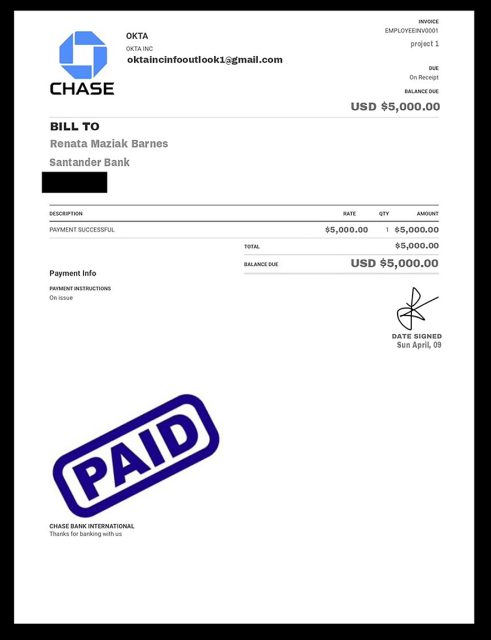
Using a Bank Logo is called Fraud!
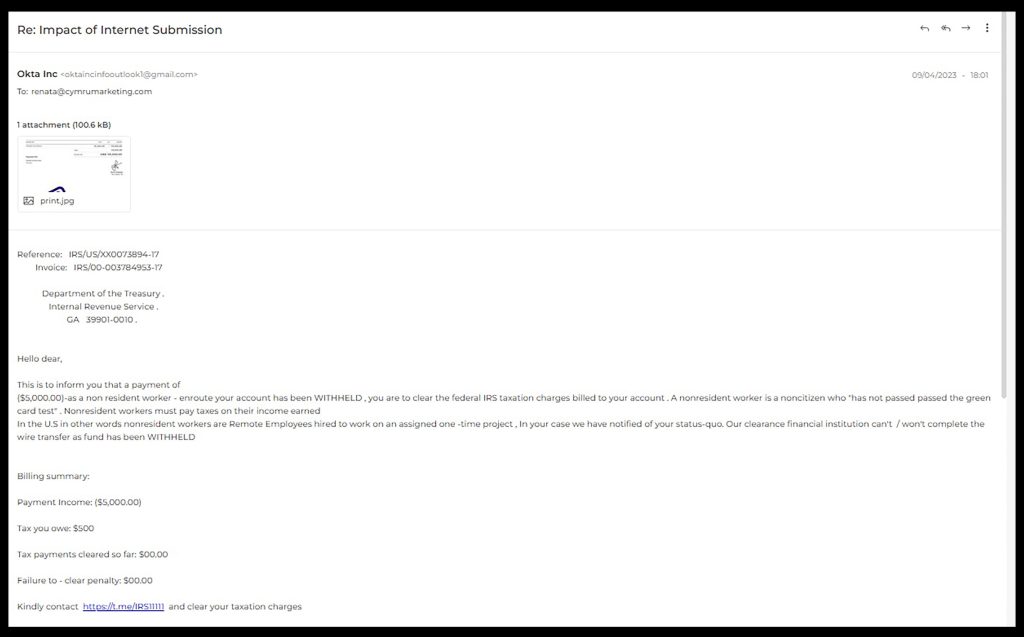
The email basically says the following for the people that find the image text too small:

Reference:   IRS/US/XX0073894-17

        Invoice:   IRS/00-003784953-17

           Department of the Treasury .

              Internal Revenue Service .

                      GA   39901-0010 .

Hello dear,

This is to inform you that a payment of

($5,000.00)-as a non resident worker – enroute your account has been WITHHELD , you are to clear the federal IRS taxation charges billed to your account . A nonresident worker is a noncitizen who “has not passed passed the green card test” . Nonresident workers must pay taxes on their income earned 

In the U.S in other words nonresident workers are Remote Employees hired to work on an assigned one -time project , In your case we have notified of your status-quo. Our clearance financial institution can’t  / won’t complete the wire transfer as fund has been WITHHELD

Billing summary:

Payment Income: ($5,000.00)

Tax you owe: $500

Tax payments cleared so far: $00.00

Failure to – clear penalty: $00.00

Kindly contact  https://t.me/IRS11111  and clear your taxation charges

Conclusion

With an understanding of the American English Language an American never starts off their emails with “Hello Dear” The people that start a conversation like this live in another continent that is all I am saying, without getting a backlash from me being racist. This is my own perception and is not meant to degrade anyone other than the scammers.

UPDATE

I have contacted the legitimate company using their online form and will update what they tell me in due course. Perhaps they themselves may evaluate my writing skills after I show them this article.

ADVERTISEMENT

If anyone wants to give Cymru Marketing legitimate work, like digital marketing or content writing although we offer many services, such as website design and development, domain brokering, and SEO, we will send you a stripe payment link for payment and all work will have to have a deposit. I am done with all the time wasters and scammers.

Cymru Marketing Content Writing Services
IONOS - Official Partner

#scammers #timewasters #contentwriting #digitalmarketing #seo #website design #websitedevelopment #cybersecurity

Ignore unrecognized telephone numbers as they could be spoofed.

Ignore unrecognized telephone numbers as they could be spoofed.

What is telephone spoofing?

Telephone spoofing is a technique used by scammers to make their calls appear as though they are coming from a different phone number than the one they are actually calling from. This is done in order to deceive the person who is receiving the call into thinking that it is coming from a trusted source, such as a bank or a government agency.

There are many different ways that scammers can accomplish telephone spoofing. One common method is known as “neighbor spoofing,” in which the scammer makes the call appear as though it is coming from a phone number with the same area code and prefix as the recipient’s number. This can make the call seem more legitimate, as the recipient may assume that it is a local call.

Another method that scammers use is known as “spoofing a well-known number.” In this case, the scammer will make the call appear as though it is coming from a well-known and trusted organization, such as a bank or a government agency. This can make the recipient more likely to answer the call, as they may believe that it is important.

Telephone spoofing can have serious consequences for the people who are targeted by scammers. In many cases, scammers will use spoofed phone numbers in order to try to steal personal information, such as social security numbers or bank account numbers. They may also try to convince the recipient to give them money, either by pretending to be a representative of a legitimate organization or by using a high-pressure sales pitch.

There are several steps that people can take in order to protect themselves from telephone spoofing. One of the most important is to never give out personal information over the phone unless you are absolutely certain that the person on the other end of the line is who they say they are. If you are unsure, it is always a good idea to hang up and call the organization directly using a phone number that you know is legitimate.

Another way to protect yourself is to use a call-blocking app or service. Many phone companies now offer call blocking as a feature, and there are also many third-party apps available that can help to identify and block spoofed calls.

In addition, it is important to be aware of the signs of a telephone scam. If you receive a call that seems too good to be true, or if the person on the other end of the line is asking for personal information that they should not have access to, it is likely a scam. Trust your instincts, and never be afraid to hang up and investigate the call further.

Overall, telephone spoofing is a serious problem that can have far-reaching consequences for the people who are targeted by scammers. By taking steps to protect yourself, such as being cautious about giving out personal information and using call-blocking services, you can help to reduce the risk of falling victim to these scams.

How I overcome scammers

Although it may affect my business I have decided to put my phone on silent calls on the Apple settings. I have also put my phone on do not disturb and only allow calls from my favorite list to come through.

As for my contact forms, I have disabled them as I was inundated with spam mail. This way anyone that has my email already can contact me otherwise they have to contact me through Facebook or LinkedIn.

When I receive a spoofed call it comes as a missed call. I obviously block them and put them in a contact list called (“parasites” 1, 2, 3, etc).

I get these calls every day and the ones which are blocked do not come up at all. It infuriates me that people go to these lengths to make money, by ripping people off. I have had on odd occasions spoken to some of them when I have forgotten to put my settings on and they become aggressive. It is usually the cryptocurrency and trading ones that continue to bombard you with questions if you say you are not interested in counteracting with a question “why are you not interested?”.

For the sake of my mental health, no one can get through to me unless I let them!

More needs to be done to teach people that these entities may spoof real numbers. The best way of knowing if a call is spoofed is not to answer it and then phone it back where there will be a voice message “this number is not recognized” or words to that effect.

Granted it is annoying, but it is better to be safe than sorry and just have incoming calls from your favorite lists coming through.

Useful Links

Phone companies ‘must do more’ to stop fraud calls – BBC News

Number spoofing scams – Ofcom

What is Phone Number Spoofing | Phone Scam (kaspersky.co.uk)

Action Fraud

https://consumer.ftc.gov/features/how-stop-unwanted-calls

https://consumer.ftc.gov/articles/caller-id-spoofing-infographic

#spam #scam #spoofing #spoofcalls #fraud #phoneblocking #onlineforms #emailaddresses #cybercrime

Telephone Encryption to Process Payments.

When Companies Do Not Use Telephone Encryption To Process Payments.

It is drummed into our heads to never give out bank details over the phone especially your CVV number (the last three or four digits on the back of the card), yet some companies still are not PCI DSS Compliant and still insist on processing payments without encryption.

Is it secure to provide debit card information over the phone?

Generally speaking – if the merchant has encryption software installed it is safe to give your card details, however giving your details to a person is not, as they can easily screenshot your information or use spy cameras and use it further down the line say a month or two. Most reputable merchants employ a number of technologies that greatly increase the security level when making payments over the phone.

One of them is your credit/debit card number, which as an owner of the card only you should know, and another is a shortcode called CVV – an abbreviation that stands for card verification value.

Printed on the back of your card, the CVV is a 3-4 digit code and its intended goal is to provide additional security when making purchases. The CVV makes sure you are in possession of the card and not someone else as the code shouldn’t be known to anyone other than the card owner.

Despite all security measures you should never forget that fraudsters are always looking for ways to beat them and steal your credit/debit card information and quite possibly even your money! This is why it is important to know how to protect your data by doing a few simple things you can further protect yourself and your earnings.

This is what you need to know and so by paying attention when providing card details, especially on the phone:

  • If using the Internet, make sure the goods or service you want to buy comes from a reputable website. With that being said, always research the company offering the service or product beforehand.
  • Never make your card details shown in public.
  • Never provide your CVV number when asked on the phone or when processing a card payment in person. This is a sure sign of impending fraud! CVV numbers are for online purchases only!
  • When making a payment on the phone, always obtain the phone number from a trusted source and make the call directly.
  • Always check your monthly bank statement thoroughly for charges you do not recognize.

PCI DSS Compliance

The Payment Card Industry Data Security Standard (PCI DSS) is made up of twelve requirements. These requirements cover a wide range of topics, including securing networks, protecting data, access control measures, information security practices, and monitoring and testing. Its overarching aim is that cardholder data be protected by any organization that stores, transmits, or processes this information. Compliance is enforced by regular audits carried out by either a professional Qualified Security Assessor (QSA), Internal Security Assessor (ISA), or through a Self-Assessment Questionnaire (SAQ).

Non-compliance can result in fines, likely to be imposed by the card issuers via the acquiring banks, for any merchant who fails to meet the required standard.

Any organization that takes credit card payments is subject to the rules laid out in the PCI DSS, and they also apply to payments taken over the phone. For those companies taking payments inside a contact center, they must make sure that they:

  • Demonstrate evidence of compliance with over 400 security controls that are applicable to any part of the contact center environment handling card data.
  • Ensure that sensitive authentication data (CVC2/CVV2 security code) is not stored in any format anywhere, including call recordings.
  • Vet new CSRs and conduct appropriate background checks; an expensive and time-consuming process
  • Make sure data cannot be removed from the call center by any means; usually by restricting the use of pens and paper and banning mobile phones from the contact center.

For a company to brush off your concerns that their payment processing methods are secure, they need to provide evidence of this when asked.

ENCRYPTION (or cryptography) makes card data unreadable to people without special information (called a key). Cryptography can be used on stored data and data transmitted over a network. Payment terminals that are part of PCI-listed P2PE solutions provide merchants the best assurance about the quality of the encryption. With a PCI-listed P2PE solution, card data is always entered directly into a PCI-approved payment terminal with something called “secure reading and exchange of data (SRED)” enabled. This approach minimizes the risk to clear-text card data and protects merchants against payment-terminal exploits such as “memory scraping” malware. Any encryption that is not done within a PCI-listed P2PE should be discussed with your vendor.

Consumer rights

Certain consumer rights in the UK mean that all card transactions come with responsibilities for the merchant.

Cardholders can raise a dispute for transactions – including those done over the phone – to their card issuer, where the retailer did not provide the product or service, deliver on its own terms, or the transaction went ahead without the cardholder’s consent. This can result in a chargeback where the merchant is charged a fee and the full amount that was disputed.

The merchant should therefore be careful to get consent for each card transaction done over the phone. To avoid chargebacks, you should consequently get enough details from the customer to back up the consent. This could be the card security code, billing address, customer name as it appears on the card, etc.

If a credit (not debit) card is used for a £100+ transaction, section 75 of the Consumer Credit Act 1974 gives the consumer the right to claim back the money for a telephone transaction they did not clearly consent to.

Anyone reading this who has concerns about a company asking for their bank details over the phone should contact us using the form below for more guidance:

https://semafone.com/blog/dtmf-masking-used-payment-processing/

Note From the Editor.

The reason for this post today is that my daughter wanted to cancel her contract early with a mobile phone provider in the UK. She first spoke to someone who said they could not make the payment over the phone because they were working from home and that they would get the billing department to phone my daughter within the hour.

It was not long after my daughter received the call from the company and she could tell it was a call center because of the background noise. The operator then asked for my daughter’s card details over the phone without encryption and the worrying part was they asked for my daughter’s CVV number.

Now if this was me and I should have warned my daughter ahead of the call that if anyone asks for a CVV number refuse to give it and just insist they send a link to a secure payment method.

The amount was quite significant and now my daughter and I are worried that her details could have been stored for a later date. It does not take much effort to write the details down or screenshot a screen. One could even use a spy camera if mobile phones, pens, and notepads are prohibited.

I will be contacting the company for comment before publishing their name and my findings with Ofcom and the card payment companies who will all be making their inquiries.

**All Card issuers and banks should have a PPI & DSS Compliance Page on their websites giving consumers an opportunity to report companies to them, for them to investigate. Furthermore, the Banks and Credit Card issuers should also spread awareness to help counteract the UK £2 Billion credit card/debit card fraud problem. Merchants should only use telephone encryption software which should be made mandatory by law.

https://www.finextra.com/pressarticle/75038/the-climbing-cost-of-fraud-over-2-billion-stolen-from-uk-credit-and-debit-cards-in-the-last-year

https://www.ofcom.org.uk/phones-telecoms-and-internet

#telephonesecurity #telephoneencryption #cybersecurity #paymentgateways #creditcardproviders #cvvnumber #tephonepayments #pcicompliance #dsscompliance

Laser Pointer Crime.

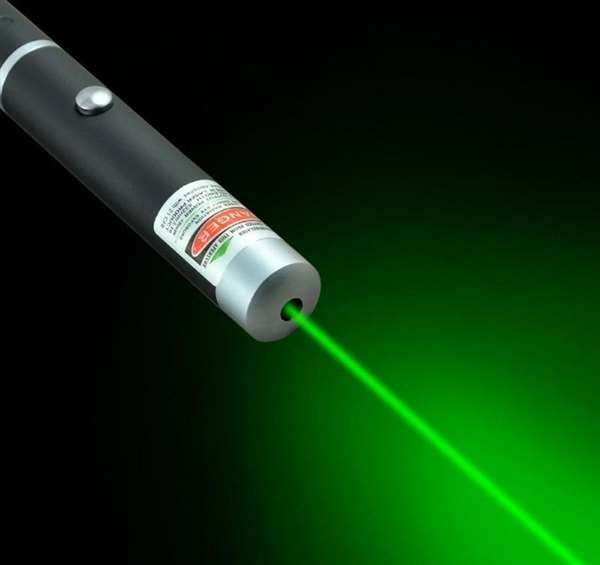
Laser Pointers are on my mind.

**Article was written and published on the 4th of March 2021 at 4.16 pm GMT.

Today and it was my fault for latching on to a post on Facebook about an appeal by South Wales Police about laser pointers, and I received some backlash for merely trying to clear up some confusion in my mind.

Facebook Group Message.

My mistake was I commented on someone’s shared post and got hate for it. It was no different from what I have said below although I have further elaborated on my statement.

The link is also here: Facebook SWPC Article. Obviously, the people or persons that pointed the laser should be punished under the terrorism act.

The reason why I latched on was that I could not believe that a simple pocket laser could cause harm or injure a pilot airborne or crew member when the culprit was on the ground, according to the original post an on-board critical care practitioner suffered blurred vision, and migraine, and had to go off-duty (This implies the injury was serious). Obviously, I was naive about laser pointers and have since learned a thing or two.

The incident happened on Sunday 28th February 2021 at 9.30 pm over Heath Roath Park and Roath Recreation Ground in Cardiff UK. The laser was directed at a Wales Air Ambulance causing injuries to a crew member.

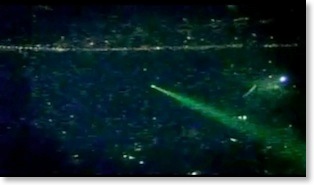
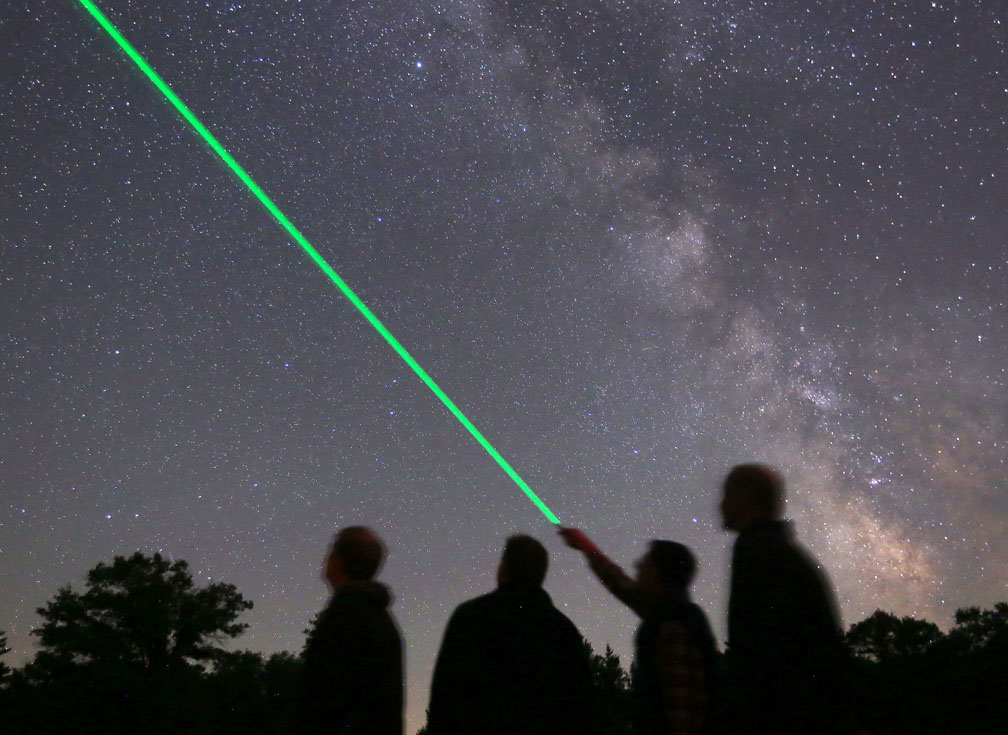
This is what a laser pointer looks like from the ground according to the blogger of this paper link below:

A laser pointer distance depends on what type of laser pointer is being used, not all fit the same mold. Laser hazard distance chart – Laser Safety Facts

For more information about laser pointers and aircraft click the link here.

I obviously did some research and fact-checking and all I got was negative people trolling me, with one stating that my shared links were belittling the crime and that what I was sharing were theoretical papers, even going as far as insinuating I had some ulterior motive to make the comment. (I do not take kindly to accusations), the said person (mentioning no names) even demanded I explain myself.

Also, it was unclear how come the pilot was not mentioned. unless the person was a paramedic and pilot.

When writing articles one should be clear about the content so as to not confuse the reader. One should not write one line and hope the reader will second guess the rest.

The only reason for the Facebook Comment if I am brutally honest was to establish facts and clear up any confusion, first of all, there was no mention of how far the helicopter was off the ground at the time of the incident?… so my question was how did the laser pointer affect a paramedics vision? Was the helicopter landing or taking off or in mid-air?

Good Journalism should not cause confusion.

A laser pointer can be a distraction for helicopter pilots that wear night vision goggles or airplanes that want to land, the same applies to military aircraft at night.

MOST IMPORTANTLY!

The most important part was I was not condoning this in any way and all perpetrators should be punished to fit the crime. I was merely pointing out that there would be no adverse physical effects from this according to the Fact Checking‘ I had made from two verified sources the BJO & BBC, links below:

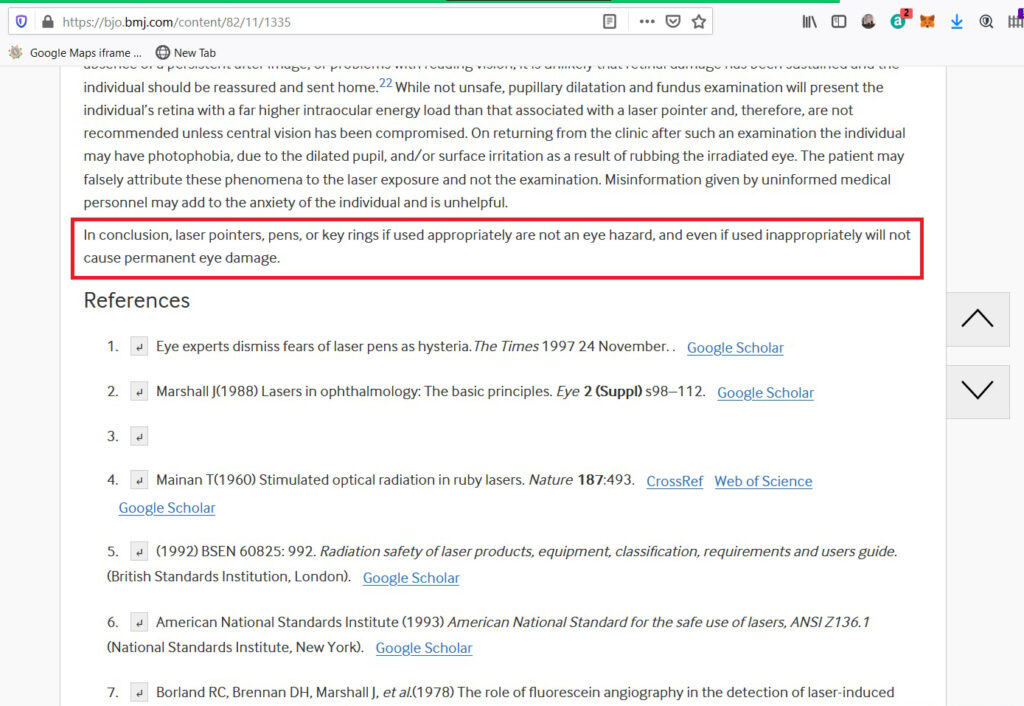
https://bjo.bmj.com/content/82/11/1335

I can see how serious pointing a laser at an aircraft can be to the aviation authority and it can be deemed as an act of terrorism and I certainly do not condone it.

Laser pointers can be distracting to pilots!

It seems to be a craze or fad for idiots to laser aircraft. Perhaps the powers that be should educate people in the masses about STUPIDITY with social awareness and media amplification that pointing lasers at aircraft is wrong on all levels, regardless if it affects a pilot or not. I can see that laser pointers can be distracting and potentially dangerous. https://www.laserpointersafety.com/laser-hazards_aircraft/laser-hazards_aircraft.html

I personally think that laser pointers should be banned from the public and only used and sold to businesses and higher education institutes. I also believe fireworks should also be banned from sale to the public or the public need a license. Fireworks should only be sold to organizations for public events or to people with fireworks licenses.

I am still open-minded about the distance a laser pointer would have had to be to cause any adverse effect to the paramedic, considering in the BJO a laser does not cause headaches, but temporary blindness similar to a flash on a camera going off.

I have since removed myself from the group. I do not know how Facebook groups work but I do not wish to be associated with narrow-minded people.

(Addendum) apparently, if you remove yourself from the group it still does not remove you from the thread, lesson learned, hence I had someone like my comment a few minutes ago.

My daughter gave me some solid advice: “if you do not want to be trolled do not leave comments as people do not like the truth”.

I never once said that I was defending or condoning the culprits, I on the contrary was fact-checking”.

All I was doing was getting my head around the fact when one verified fact-checked source said one thing and I read something else from another source that is confusing and that is when I started to question the credibility of the information.

From what I can gather according to my verified source below, it is virtually impossible to have adverse physical effects from a laser on the ground whilst a pilot is airborne. If anything it can be a distraction when pilots wear nighttime goggles or are landing and may experience flash blindness.

However pointing a laser at an aircraft is an obstruction and should carry the punishment of an act of terrorism (and if it isn’t, it should be).

According to the Civil Aviation Authority in 2016, there were 1,258 incidents of lasers being pointed at aircraft. In the future, those who deliberately target aircraft with lasers could face a jail sentence or hefty fine. Currently, shining lasers at planes has a penalty of up to £2,500.
https://www.independent.co.uk/news/uk/home-news/laser-pointers-blind-pilots-uk-government-aircraft-attacks-civil-aviation-authority-eye-injury-a7890146.html

Pointing a laser pointer at an aircraft is illegal (so don’t do it regardless of what pointer is being used).

Obviously, I reiterate again, pointing a laser at a moving vehicle such as a plane, helicopter, car motorbike, boat, yacht, etc can be deemed as an act of terrorism, it does not matter why a perpetrator has engaged in such an act but more so that they executed their action and this is punishable by law.

For pilots to be affected and injured because of this act, the laser would have to directly be pointed at their eyes, or for they to experience a flash-blind effect.

According to The British Journal of Ophthalmology (BJO)

While many claims have been made for ocular and other injuries, as a result of exposure to laser pointers, none has been sustained. Most victims are unaware of the clinical symptoms that would be appropriate to retinal injury; thus many individuals claim to have seen a bright light followed by pain or irritation in the irradiated eye. Some also complain of redness of the eye and headaches. In reality, there are no pain receptors in the retina and, therefore, threshold laser strike in the visible region of the spectrum is not associated with pain.

https://bjo.bmj.com/content/82/11/1335

Maximum Jail Term. Yes, a maximum punishment should be served to idiots using laser pointers for illegal means and maximum jail time should apply, as it could potentially cause a catastrophic disaster. This also applies to drones. https://www.gov.uk/government/news/drones-are-you-flying-yours-safely-and-legally

I personally think all journalists and media should use the phrase:

“Anyone caught using a laser pointer publically for illegal purposes will be arrested and punished under the terrorism act”, which adds MORE CLOUT than a minimum sentence of 5 years, going as far as spreading awareness in bold campaigns that show how dangerous laser pointers can be.

“Good Journalism Does Not Cause Confusion”.

It does not take much effort to log details of who the device was sold to, making verification ID mandatory in the UK. However, to stop people from buying them from abroad is another matter and there would have to be an import ban from other countries to the consumer and only legitimate organizations that were licensed would have access.

UK Ministers are talking about bringing in licenses to sell laser pointers: https://www.independent.co.uk/news/uk/home-news/laser-pointers-blind-pilots-uk-government-aircraft-attacks-civil-aviation-authority-eye-injury-a7890146.html

According to The British Journal of Ophthalmology (BJO

BJO states and I quote “that in conclusion, laser pointers, pens, or key rings if used appropriately are not an eye hazard, and even if used inappropriately will not cause permanent eye damage”.

FINAL THOUGHTS.

“It is sad that in this day and age with an array of social media platforms, we are censored for the things we write. I am all for censorship if it promotes hate crime or worse. But when it comes to merely expressing an opinion or asking a question we should not be scrutinized. There is little room for freedom of speech anymore and we cannot ask questions as people will question our motives and get defensive. I believe if people have questions they should be able to express them without the fear of someone trolling them and without the fear of being censored or punished”.

Pointing any laser device to a moving vehicle eg: (planes, trains, cars, motor bikes, boats) or directly at someone to purposely maim including eyes and body, for the purpose to cause destruction and accidents, the perpetrators should be punished to fit the crime.

Further Reading:

https://www.askthe.police.uk/content/Q757.htm

https://www.mentalfloss.com/article/65424/what-pilots-see-when-you-shine-laser-pointer-aircraft

According to this article distances of up to 1200 feet can engulf a cockpit. It remains a distraction hazard all the way up to 12,000 feet.

The point is:

The maximum altitude that a helicopter can be reached during forward flight typically depends more on the ability of the engine. Helicopters can reach around 25,000 feet. But the maximum height at which a helicopter can hover is much lower – a high-performance helicopter like the Agusta A109E can hover at 10,400 feet. However, if the helicopter remains in ‘ground effect’ – ie, if it is hovering close to high ground – its maximum hover altitude will be higher. The Agusta can hover in ground effect – ‘HIGE’ in helicopter jargon – at 13,800 feet. This is useful for mountain rescue missions.

https://www.laserpointersafety.com/laser-hazards_aircraft/laser-hazards_aircraft.html

According to the BBC:

I would also like to add I am a law-abiding citizen and if I was to catch anyone pointing lasers for illegal purposes, other than for the purpose of business, education, or pet entertainment, I would report them to the authorities without question.

Here is the post to the South Wales Appeal Page: https://www.facebook.com/SWPCardiffVOG/posts/2948640848753159 Anyone with information should contact Crimestoppers anonymously on 0800 555 111 quoting ref *071640.

#laserpointers #laserpointercrime #laserpointerlaw #laserpointerdistance #factchecking #goodjournalism #laserpointerterrosism